

 Back
AI or Not's AI Video Detector Flags Taiwan Election Smear Campaign from China
Days before Taiwan votes, an election smear campaign linked to China is flooding feeds with AI videos aimed at the ruling party and its candidates. AI or Not's AI video detector flagged videos and images of Puma Shen as AI-generated.
AI is becoming the weapon of choice for political campaigns: AI or Not's AI video detector flagged two AI-generated smear videos aimed at Puma Shen, the Democratic Progressive Party's candidate for mayor of Taipei, three days before Taiwan votes.
The stakes are bigger than one city. Taiwan elects mayors and councils on Saturday, a barometer for the 2028 presidential race, while a flood of AI election misinformation tries to turn voters against the ruling party. The two clips we flagged are skits. In one, a classroom of black bears sits at school desks while a teacher with wild hair and glasses glares at the camera, then hoists a desk over his head. The caption says to learn English with "teacher Boyang," which is Shen's given name. In the other, a man in a rainbow bear costume and a nervous man in a white shirt huddle over a red box in a cluttered apartment at night. The caption says Boyang borrows 5 million and has to repay 10 million.
Both are cartoonish, and both carry an "AI" mark in the corner. They are also two clips in a much bigger pile. Investigators and Taiwan's government link the wider campaign to China, and Beijing denies it. Reporting on that China-linked network counts more than 500 AI videos aimed at the DPP over the past year, with tens of millions of views since May 2025 and more than half of those views in the last four months. What we flagged is two skits from one public Threads account that posts them in volume. Nothing we found ties that account to the network. Taiwan votes Saturday, Nov. 28.
AI or Not has already been cited in this election's fact-checking. DW's fact check of the campaign cites AI or Not on a fake image of Shen appearing to use drugs, saying the tool "indicates that this photo is likely AI-generated."
 The fake drug image of Shen as it was posted on Facebook, flagged as AI-generated by AI or Not's AI image detector. Source: Facebook.
Key Takeaways
- AI or Not's AI video detector flagged two smear videos from one Threads account as AI-generated, days before the Nov. 28 vote: a classroom skit and a loan skit, both captioned with Shen's name.
- Shen co-founded a research group that tracks Beijing's influence operations. China's Taiwan Affairs Office has listed him as a separatist and sanctioned a company linked to his father.
- Political experts say the goal of these campaigns is to make voters distrust the DPP and the democratic process, not to elect one party.
- A smear repeated hundreds of times is hard to undo. Research on the illusory truth effect and the continued influence effect says why, and a 2026 experiment found warnings didn't stop a deepfake from shaping judgments.
- AI or Not's detectors have been used on political fakes around the world, most recently in Indonesia and France, and on a fake drug photo of Shen in this election.
AI Smear Videos Flood Taiwan Before the Vote
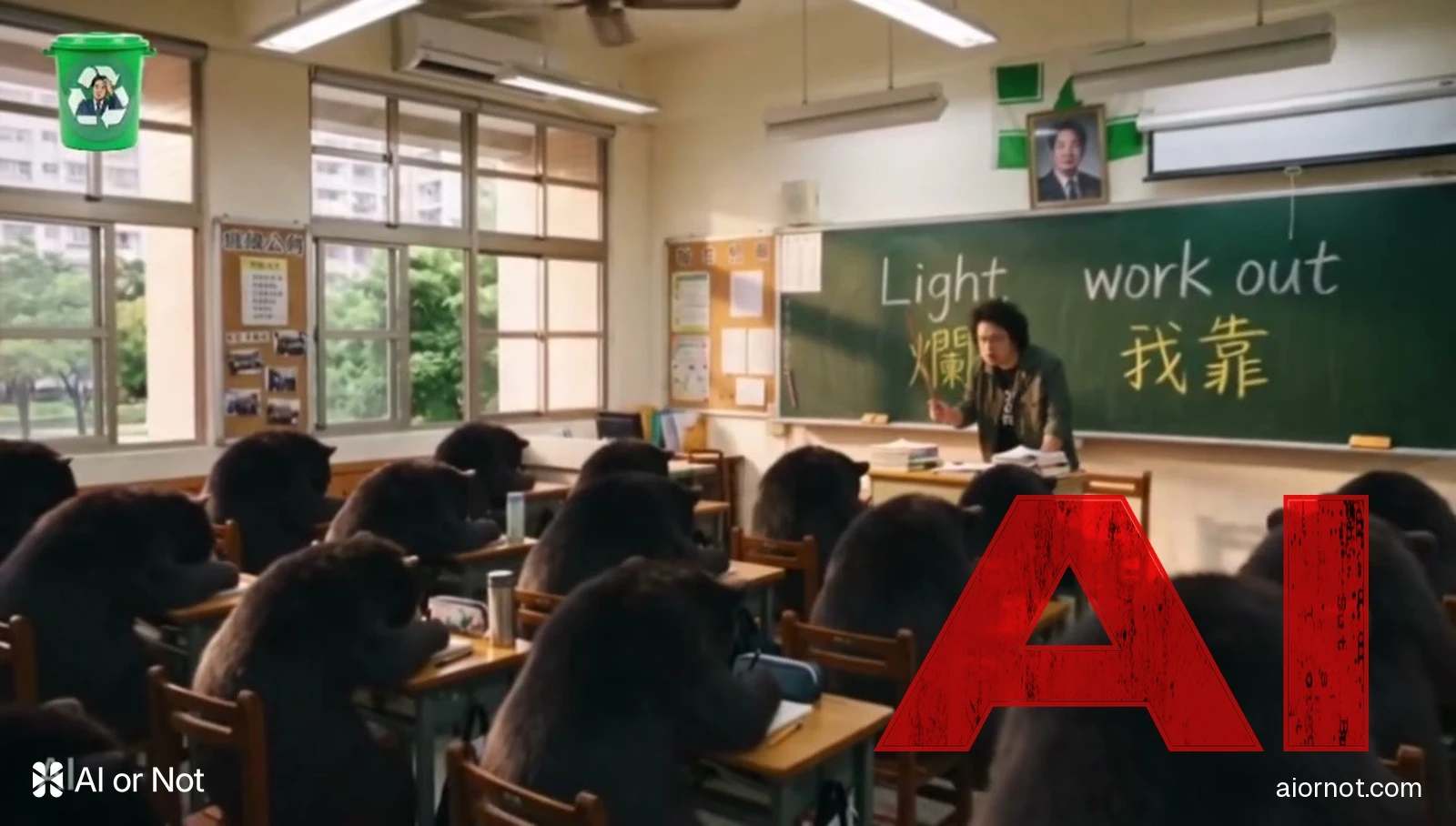 Frame from the classroom skit, flagged as AI-generated by AI or Not's AI video detector. The small "AI" mark in the corner is in the original post. Source: Threads.
A Chinese-language investigation collected 174 "red bear" Shen videos, posted between August 2025 and November 2026. Bears are the motif, and commenters often called them cute.
The counts differ by who is counting. A Taiwanese government report said 260 accounts spread more than 2,150 AI-generated videos, most targeting DPP politicians. A researcher at Taiwan's National Institute of Cyber Security told the same Chinese-language investigation that at least 194 accounts posted 1,865 AI political videos over a bit more than a year. Different scopes, different counts.
The videos also make claims. Each one has been denied:
- President Lai Ching-te. Videos say he holds a US green card and would abandon Taiwan if war broke out. Taiwan's presidential office says that is completely false and misinformation.
- Shen and drugs. Fabricated images and video appear to show Shen using drugs, which he denies. A digital literacy group found the clip was a Chinese netizen's video with a swapped face, and AI or Not's AI image detector indicated the drug photo was likely AI-generated, as cited above.
- Shen and kickbacks. An audio clip posted Oct. 29 claims to capture Shen admitting to arms-deal kickbacks. The Justice Ministry's Investigation Bureau said it was synthesized with deepfake technology, and prosecutors indicted a 49-year-old man in Taoyuan for reposting it. Prosecutors said the original came from a throwaway account and its maker is unknown.
Why Taipei's Mayoral Race and Puma Shen Are Targets
Shen is a criminology professor who co-founded Doublethink Lab, a research group that tracks disinformation and Beijing's influence operations. He also co-founded Kuma Academy, which trains civilians in defense preparedness, and has sat in parliament since January 2024. "We try to tell other countries, hey, you need to be aware of this Chinese influence operation in your country," he said. Now they need everyone needs to be aware of AI influence operations.
Beijing has been pressing on him for years, and not only through videos:
- The Taiwan Affairs Office put him on its list of "obstinate Taiwan independence separatists" in October 2024, and Chongqing police listed him as wanted for alleged secession.
- On Oct. 14, the office sanctioned a company linked to his father and said Shen was "in no position to talk about cross-strait exchanges and cooperation," after he opposed Taipei's role in a Taipei-Shanghai forum.
- A television host who attended his campaign launch saw Chinese businesses distance themselves, and an automaker pulled promotional content, according to one analysis. The same analysis says a supporter sign-up page was flooded with more than 70,000 fake registrations in an hour.
The office has called him a "traitor" exploiting fears of China to win votes. Beijing has long rejected accusations that it interferes in Taiwan's elections.
Taipei is also the prize. Its mayoralty was long a stepping stone to the presidency, and the race against incumbent Chiang Wan-an of the Kuomintang (KMT) is close. Mid-November polls put the two within the margin of error, and Taiwan's poll blackout in the final ten days means nobody has fresher numbers.
What Beijing Gains and Whether It Has a Favorite Candidate
China claims self-governing Taiwan as its territory. Ties have worsened since the DPP took power in 2016, and Xi Jinping has called "reunification" a key goal. Beijing talks to the KMT, which traditionally favors closer ties: Xi met KMT chair Cheng Li-wun in April, their first leader meeting in almost a decade, and has refused to deal with the DPP.
So does China have a candidate? One analyst wrote that Beijing "seems to have taken steps to support its preferred candidate," Chiang, pointing to Facebook pages, several run from Hong Kong, that published flattering stories about him. The same piece says "no link to Chiang's campaign has been verified, and he has publicly opposed foreign influence." His campaign has said that "no outside force should exert political pressure on Taiwan's democratic elections."
Several experts say that is the wrong frame.
"The account operators are trying to make people distrust the DPP politicians so that they will not believe whatever they say."
That is Austin Horng-En Wang, a political scientist at UNLV, telling BBC. China analyst Andrew Yeh said such operations succeed by "degrading Taiwanese citizens' trust in their democratic processes," and that a "more fractured and more divided Taiwan is in Beijing's interests" whichever party wins. A Taiwanese security official, speaking anonymously, said the operators make people "turn against each other, grow disgusted with democracy, choose not to vote."
Fake "the US will abandon Taiwan" clips travel alongside the skits, and experts say they're meant to weaken trust in American security commitments.
Why Hundreds of AI Videos Work Better Than One
The shorthand people reach for is "frequency bias." Psychologists call it the illusory truth effect: a claim you have heard before feels more likely to be true. In one well-known study, it held even when people knew the right answer. Nobody believes in a classroom of bears. A drug claim or a kickback claim, repeated across hundreds of clips, is another matter, because those are plausible.
Corrections don't fully undo it either. Researchers call that the continued influence effect: a claim that has been retracted keeps shaping what people think of the person it was about, and it sticks harder when it was repeated before the correction arrived. Shen's debunked audio and drug clip fit that pattern.
The label fades and the scene stays. People tend to remember what they watched and forget the "AI content" tag or the fact that it was meant as a joke. In a 2026 experiment, most participants still relied on a deepfake video's content after being warned it was fake. "It's satire" does less than people hope.
How AI or Not's AI Video Detector Checked the Smear Videos
We pulled videos from a Threads account that was still public and posts these skits, @chase_2183, and ran them through AI or Not's AI video detector. Threads labels the account's posts "AI content." A Chinese-language investigation lists it among the most active posters of Shen skits, with 29 of the 174 videos, and did not tie it to China or to coordinated behavior. Nothing we found does either.
AI or Not's AI video detector flagged both the classroom skit and the loan skit as AI-generated.
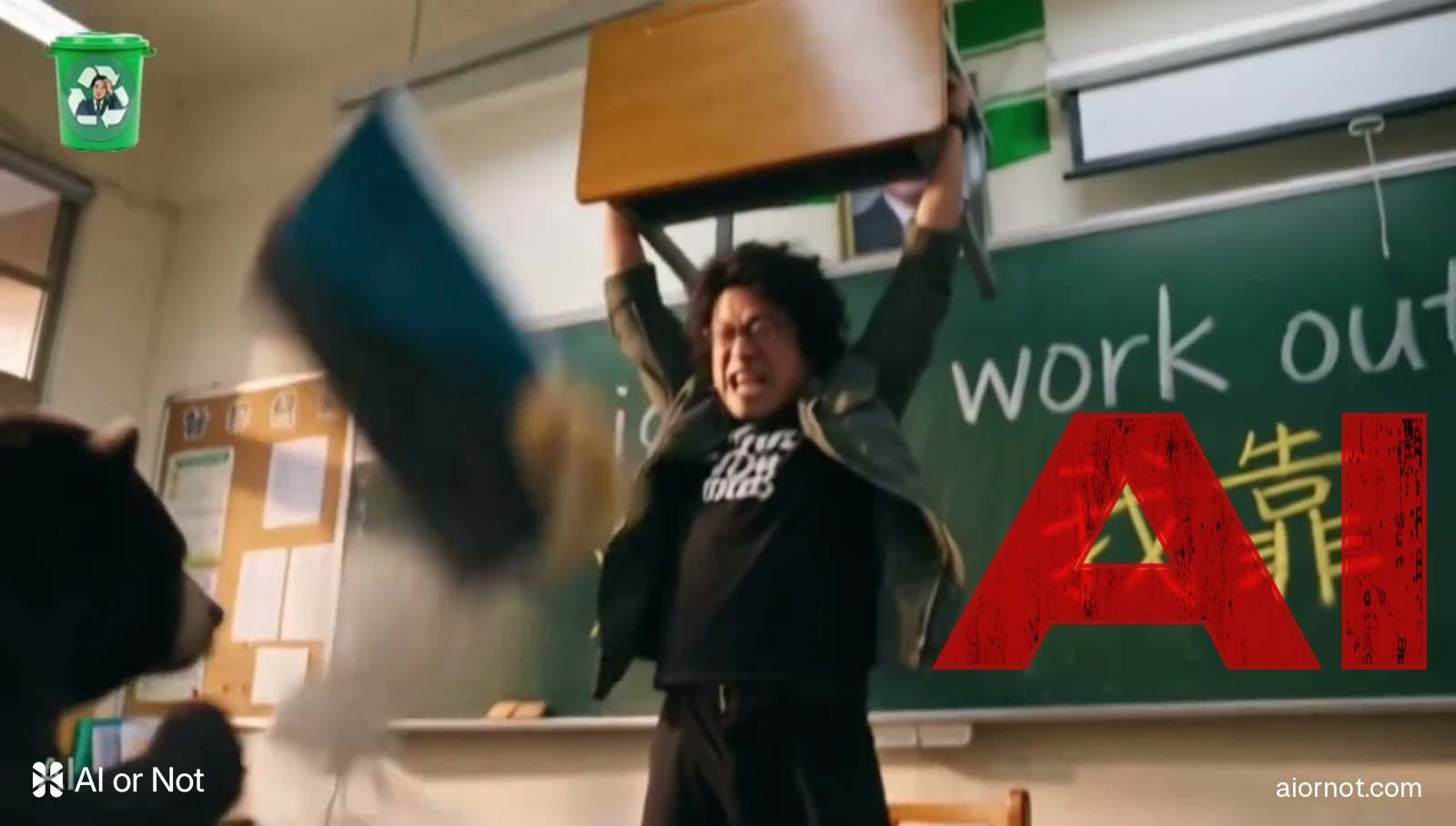 A second frame from the classroom skit, which AI or Not's AI video detector flagged as AI-generated. Source: Threads.
 Frame from the loan skit, also flagged as AI-generated by AI or Not's AI video detector. Source: Threads.
AI or Not's Record on Political Deepfakes
Elections are one place AI or Not's detectors keep getting used. On Nov. 23, Indonesian police cited AI or Not's AI image detector in a notice debunking a fake poster of President Prabowo inaugurating a new vice president while the real seat sat empty. AI or Not's AI detection flagged the AI Pink Panther protest photos built from other countries' street pictures during France's protests. And AI or Not flagged AI-generated proof-of-life images of Kim Jong Un, a leader under rumor.
Platforms, newsrooms and election teams can run the same checks on video, images and voice through the web app or the API. A skit that looks like a joke gets the same check as a clip that looks like news.
How to Check a Campaign Video Before Saturday
- Find the earliest upload. The first account to post it often says what it is.
- Look for an AI label or watermark. Threads marks some posts "AI content," and many skits carry their own "AI" mark. Labels are easy to crop.
- Find a real source for the claim. If a video says a candidate admitted something, look for the original recording, or for a statement from anyone who was in the room.
- Run the clip through AI or Not's AI video detector. It checks the video itself, not the label on it.
FAQ
What Is AI or Not's AI Video Detector?
It checks whether a video was generated by AI. For this story, it flagged two skits aimed at Taipei mayoral candidate Puma Shen as AI-generated.
Who Is Puma Shen?
Shen is the Democratic Progressive Party's candidate for mayor of Taipei and a member of parliament. He co-founded Doublethink Lab, a group that tracks Beijing's influence operations, and he is running against incumbent Chiang Wan-an of the KMT in the Nov. 28 election.
Is China Behind the AI Videos About Taiwan's Election?
Published reporting describes a China-linked network behind more than 500 of these videos, and Beijing has long rejected accusations that it interferes in Taiwan's elections.
Why Do Repeated AI Videos Change How People See a Candidate?
Hearing a claim again and again makes it feel true (the illusory truth effect), and a correction doesn't fully erase it (the continued influence effect). A label saying a video is AI or satire can fade from memory while the scene sticks.
The skits from the account we checked were still public when we pulled them, AI still there.

What do you get with AI or Not?
Instantly get your AI detection API to start building, and protecting.

AI detection covering images, text, video and audio.
All content checked gets deleted, instantly.
Start detecting AI for free, scale with pay-as-you-go.
AI to fight AI.
