
 Back
BackBollywood Celebrity Deepfake Detection
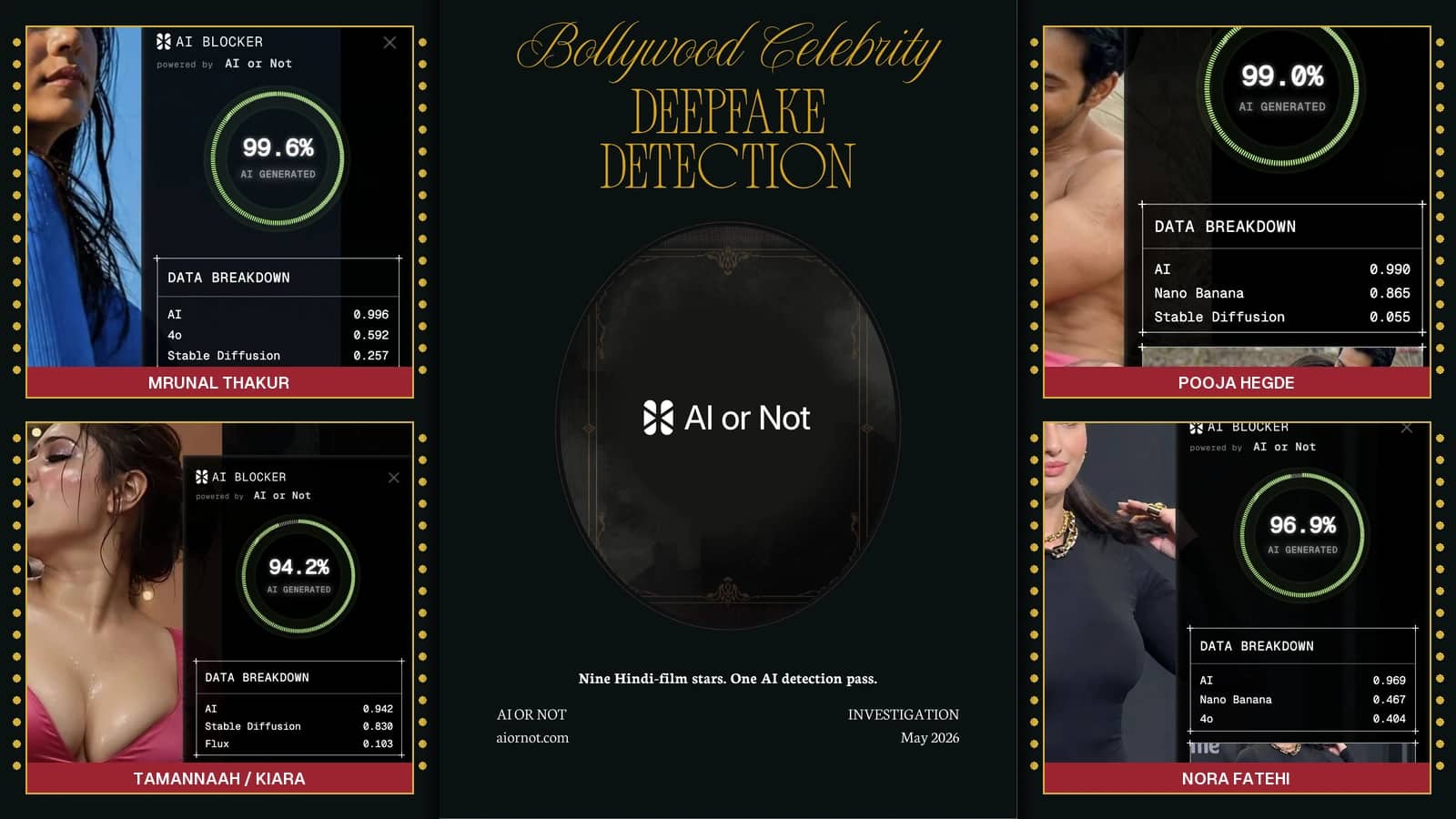
Nine Hindi-film stars, one common pattern: AI-generated intimate imagery posted at scale on X. Here's what AI or Not flagged.
You probably remember the Rashmika Mandanna elevator video. The fake one. November 2023, a clip of a woman in a black bodysuit walking into a lift, except the woman's face had been swapped for Mandanna's. It went viral before anyone could catch it, and it put the word "deepfake" on the front page of every Indian newspaper for a week.
Two and a half years later, the playbook has changed.
The face-swap on existing video, technically demanding, traceable back to a source clip, has largely been replaced by something faster and harder to pin down: fully AI-generated images, built from scratch, posted on social media and X under the cover of fan-tribute accounts. The actresses being targeted are largely the same. The harm is the same. What's different is the tooling, and how trivially easy it's become to deploy.
When we ran a set of circulating images through AI or Not's AI detector, the results came back consistent across nine Bollywood actresses: AI-generated. These are not face-swaps. They're synthetic images that never involved the women's actual bodies, generated from scratch and posted at scale. According to the National Crime Records Bureau's 2024 report, cybercrime cases in India crossed 101,000 (1.01 lakh) for the first time last year, and the National Cybercrime Reporting Portal logged a 118.4% increase in reported online crimes against women between 2020 and 2024. The "Make It Real" study published by Tattle Civic Tech and the RATI Foundation in 2025 found that 10% of all calls to RATI's Meri Trustline online abuse helpline now involve deepfakes or AI-manipulated sexual images. The IT Rules amendment that came into force on November 15, 2025 is now being tested against exactly this pattern, in real time.
Globally, 99% of deepfake explicit content targets women, according to research published at the 2025 ACM Conference on Fairness, Accountability, and Transparency. India's film industry, with its massive fanbase and high-profile actresses whose public images are extensively documented, has become one of the primary targets.
Key Takeaways from Indian Deepfakes
- The "Make It Real" study from Tattle Civic Tech and the RATI Foundation (2025) found that 10% of all calls to RATI's Meri Trustline helpline now involve deepfakes or AI-manipulated sexual imagery.
- 92% of women reporting deepfake abuse to the helpline are ordinary women, not public figures, indicating the technology's reach goes far past the celebrities seen in headlines.
- The National Crime Records Bureau 2024 report logged cybercrime cases crossing 101,000 (1.01 lakh) for the first time, with online crimes against women rising 118.4% between 2020 and 2024 on the NCRP portal.
- 99% of deepfake explicit content targets women, per 2025 ACM FAccT research.
- AI or Not flagged images of nine Bollywood actresses as AI-generated.
- India's IT (Intermediary Guidelines) Amendment Rules came into force November 15, 2025, requiring platforms to visibly label AI-generated content covering at least 10% of the frame.
- Takedown windows: 2 hours for nude or highly invasive deepfakes, 36 hours for intimate images, 7 days for other synthetically generated content. Non-compliance costs platforms their Section 79 safe-harbour protection.
- Delhi HC personality rights: Sadhguru (May 2025), Aishwarya Rai Bachchan (September 2025), and Rajat Sharma (November 2025) all secured court-ordered 36-hour takedown regimes against AI-generated misuse of their likeness, several months before the IT Rules made it statutory.
The Mandanna Inflection Point for Deepfakes
Rashmika Mandanna said at the time: "Something like this is honestly, extremely scary not only for me, but also for each one of us who today is vulnerable to so much harm because of how technology is being misused." She was right about the "each one of us" part. Within weeks of the elevator video, similar content targeting Katrina Kaif, Alia Bhatt, and Kajol was circulating on the same platforms.
What that moment did was force a public conversation India had been avoiding. The government issued warnings. Delhi Police filed an FIR. Union Minister Rajeev Chandrasekhar said deepfakes were "the latest and even more dangerous and damaging form of misinformation." None of that stopped the next wave.
AI Slop in Circulation
The accounts posting this content style themselves as fan pages, with grid layouts mixing real promotional photos alongside generated images. They look, at a glance, like tribute pages. The generated images are tagged with celebrity names and paired with text designed to maximize engagement: "single now," relationship bait, fabricated kiss photos. The generation itself happens offline, on consumer hardware, from models that don't leave a public trace.
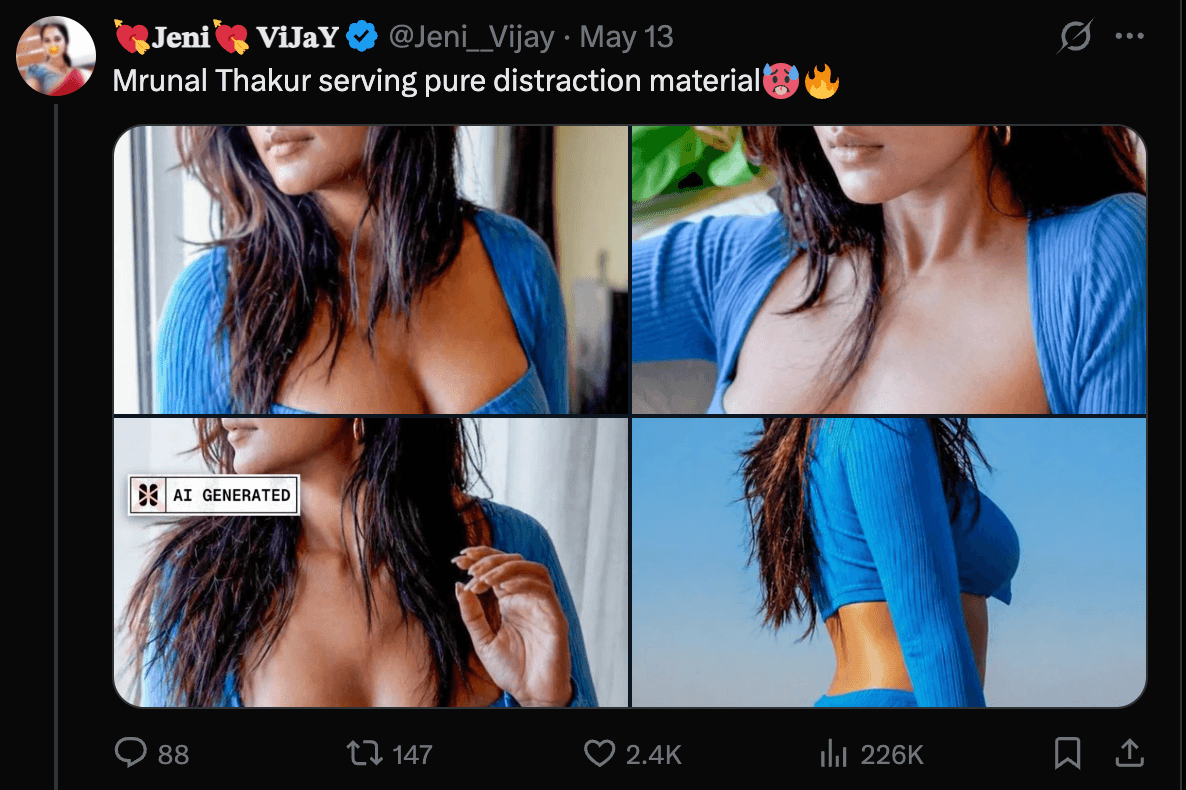
X posts in this batch had view counts ranging from the hundreds of thousands into the millions before any action was visible. Several had active engagement (likes, reposts, comments) at the time of capture. One had a community note rating prompt attached, suggesting X users had already flagged it, without it coming down.
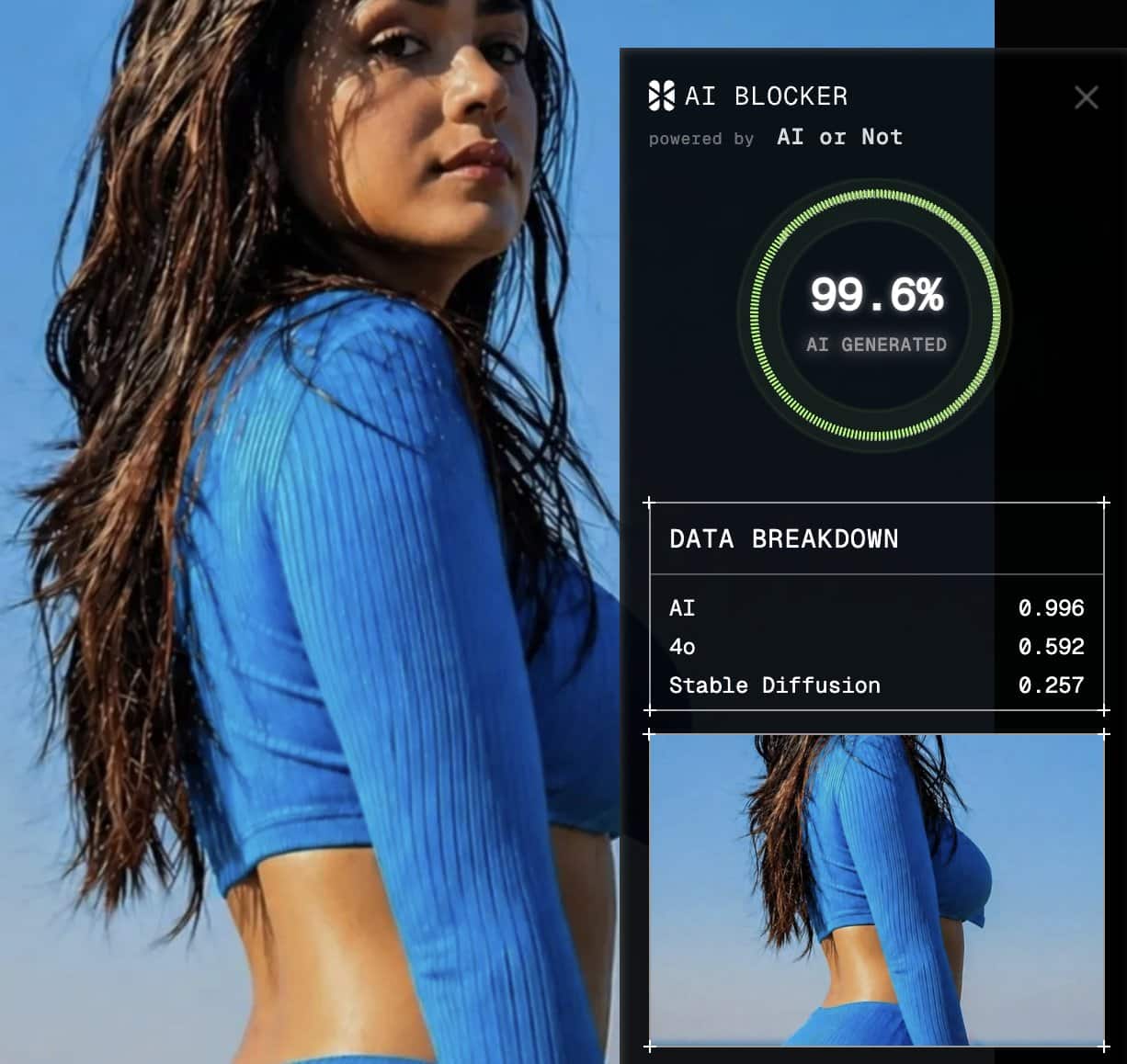
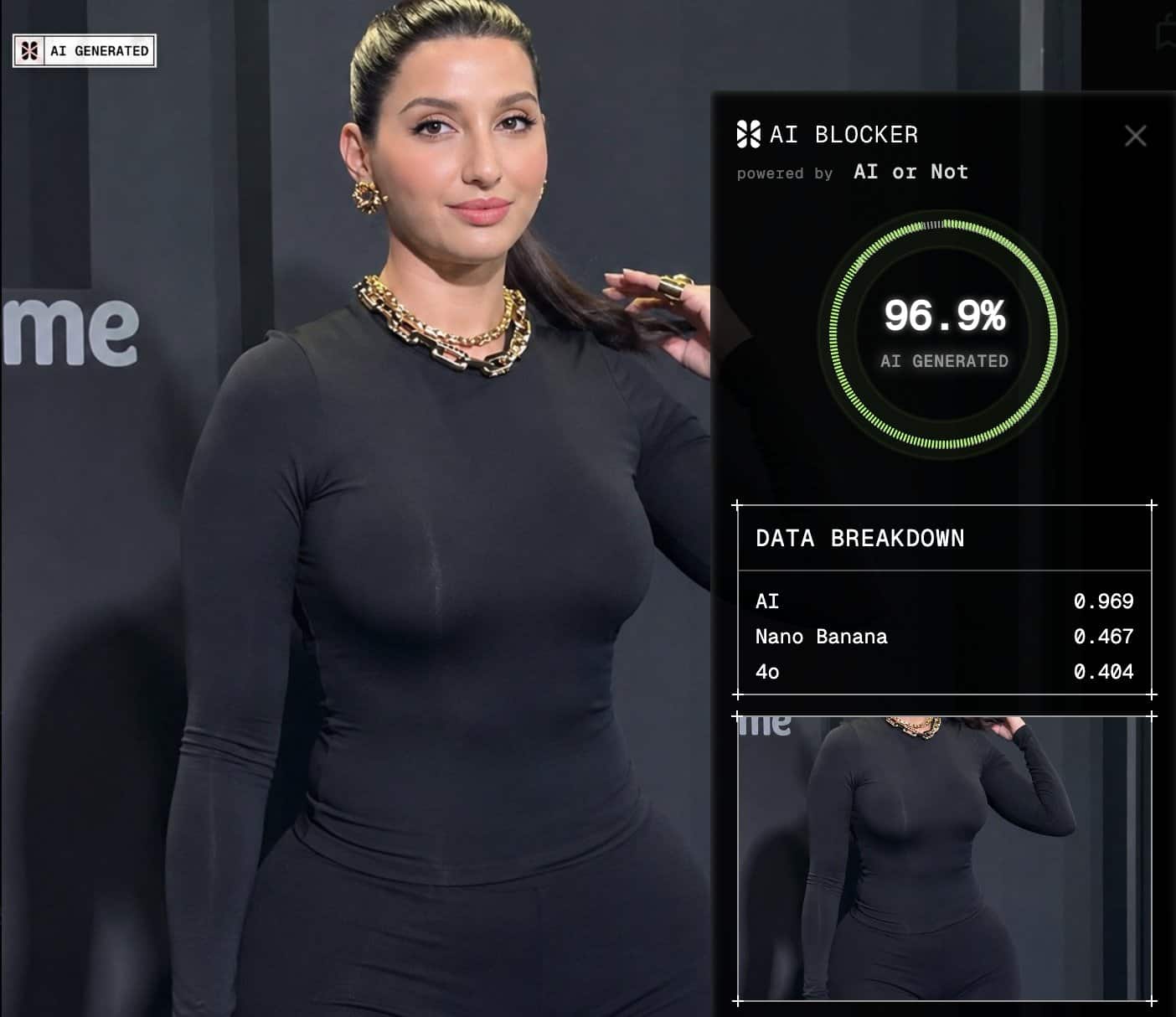
Where shown below, the X post screenshot is paired with the AI or Not detection panel for the exact image being highlighted. Explicit variants from the same posts have been withheld; the detection result for those is documented in the prose.
The Bollywood Actresses Being Deepfaked
Mrunal Thakur
Sita Ramam (2022) was the film that made Mrunal Thakur's reputation outside Hindi cinema. Before it, she'd spent years on television in Kumkum Bhagya, then crossed over to Bollywood opposite Hrithik Roshan in Super 30 (2019). Hi Nanna (2023) added a Filmfare Best Actress win. The images circulating under her name on X came back as AI-generated.
Mouni Roy and Disha Patani
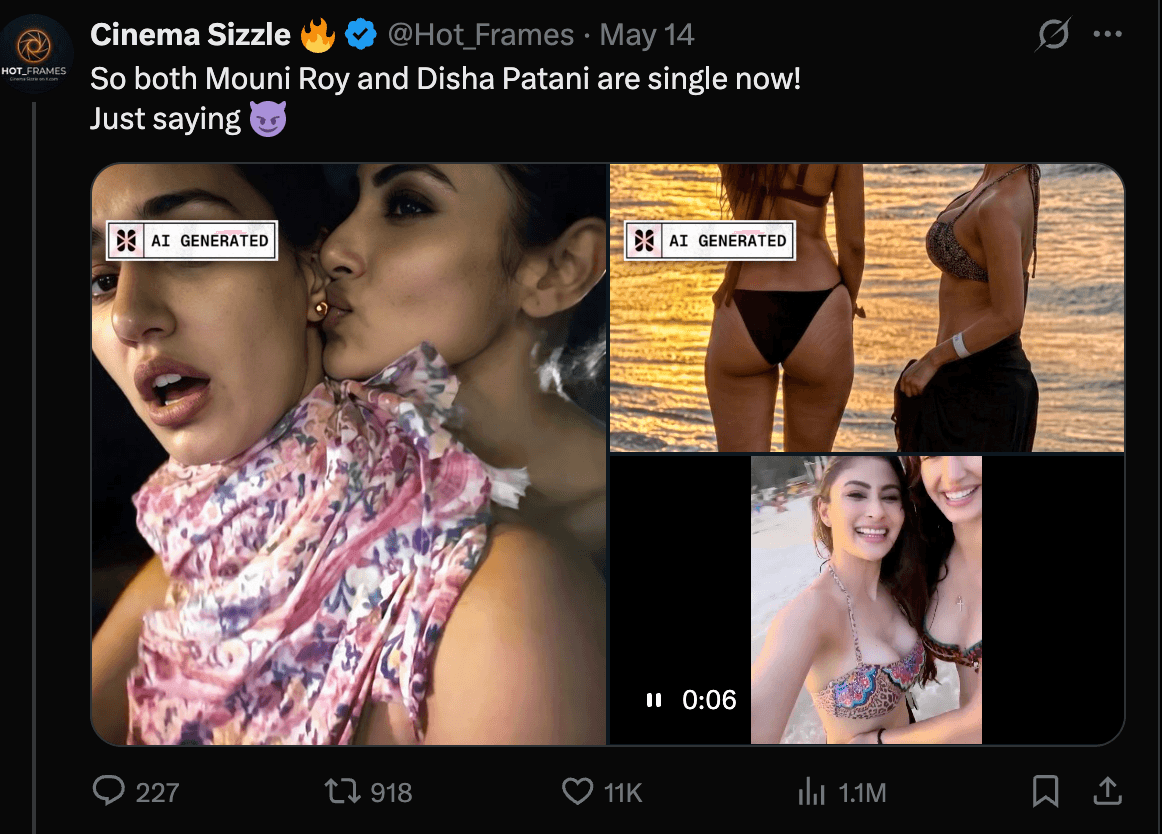
Mouni Roy became a household name through the Naagin franchise, then moved to Hindi film: Gold (2018) grossed about $18 million (1.5 billion rupees); she played the antagonist Junoon in Brahmastra (2022). Disha Patani debuted in MS Dhoni: The Untold Story (2016). She's been a fixture in action films since, with Baaghi 2 (2018), Malang (2020), and a crossover into Kalki 2898 AD (2024).
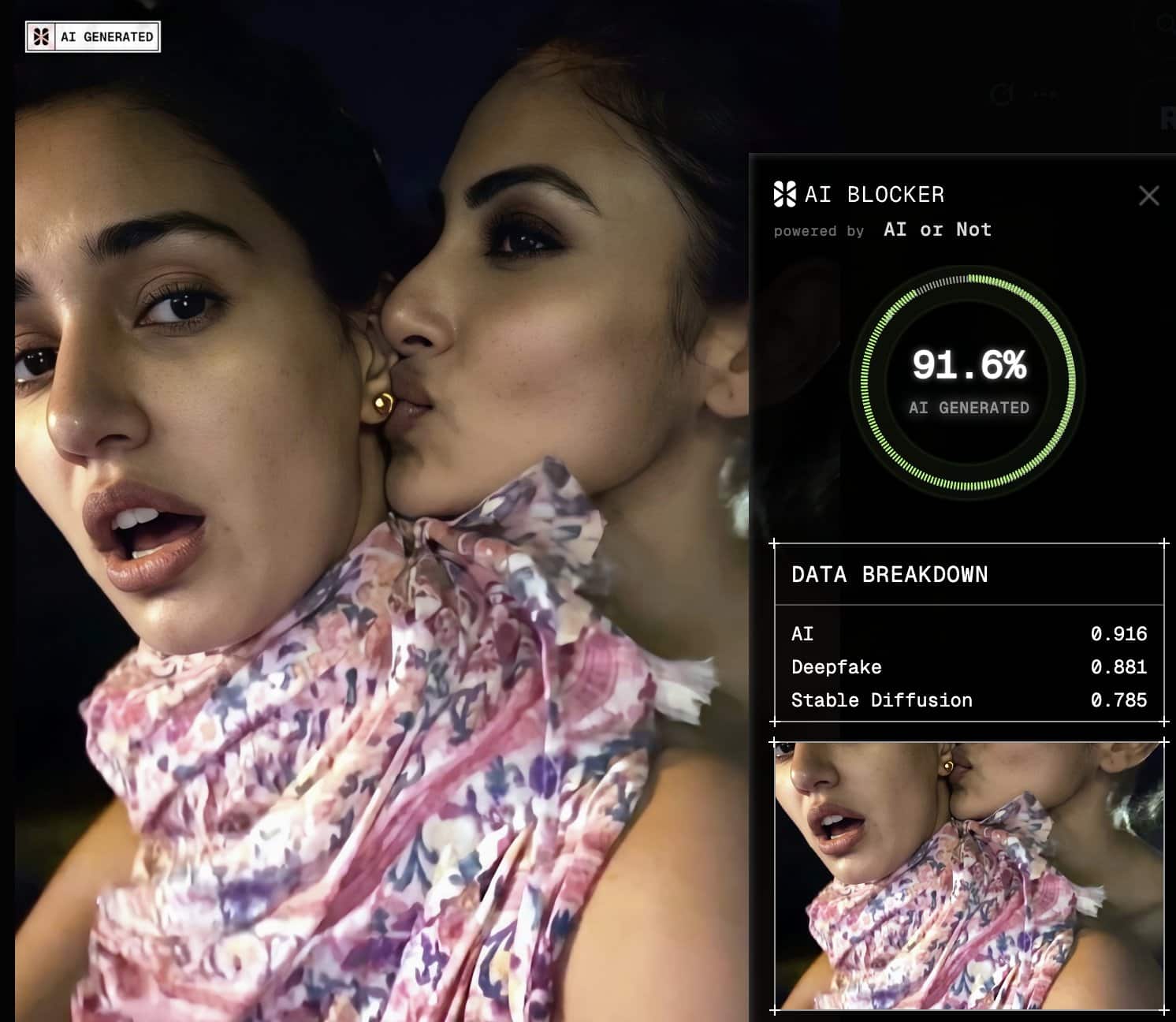
The post pairing them positions both as "single now," using relationship framing as bait around a generated kiss image. AI or Not flagged it as AI-generated.
Tamannaah Bhatia and Kiara Advani
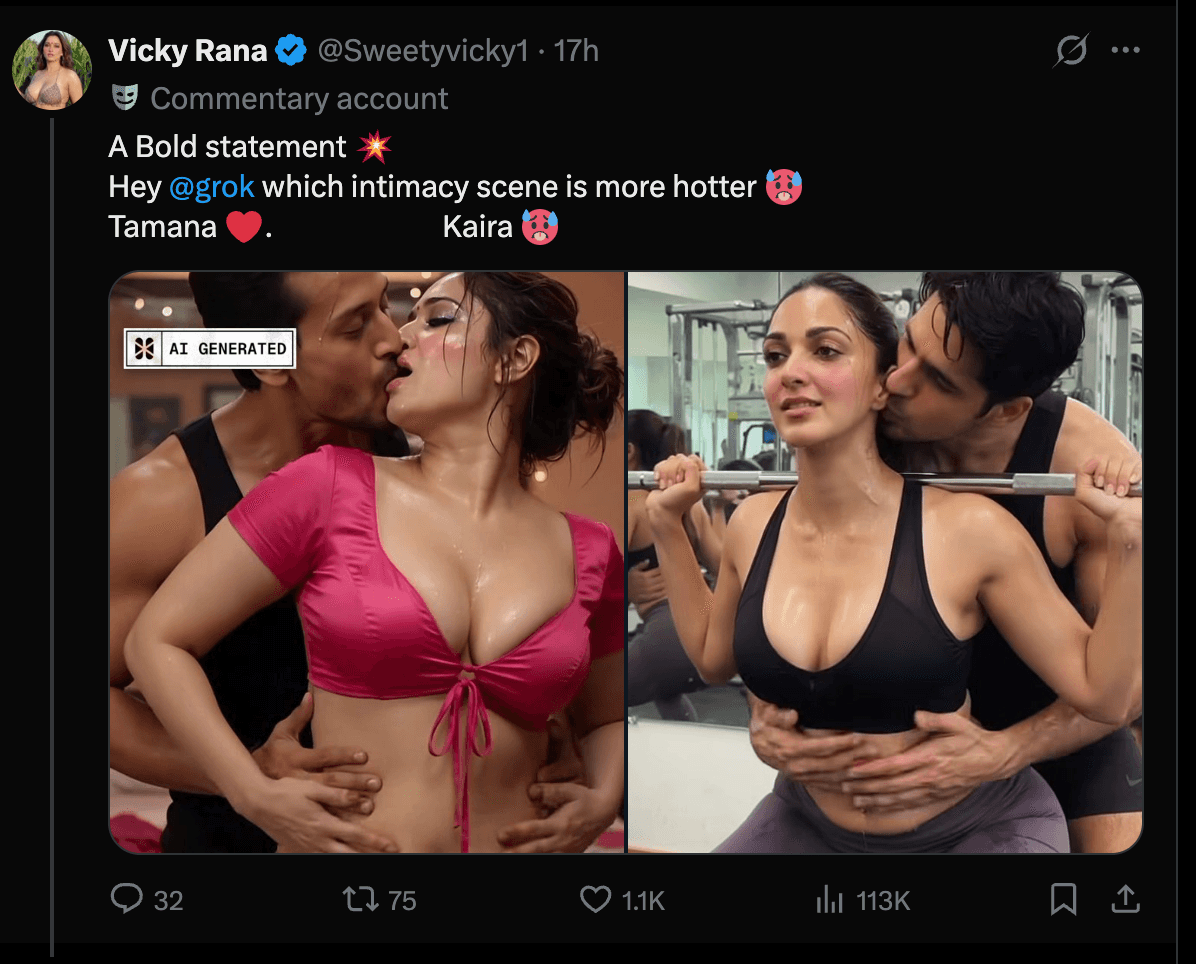
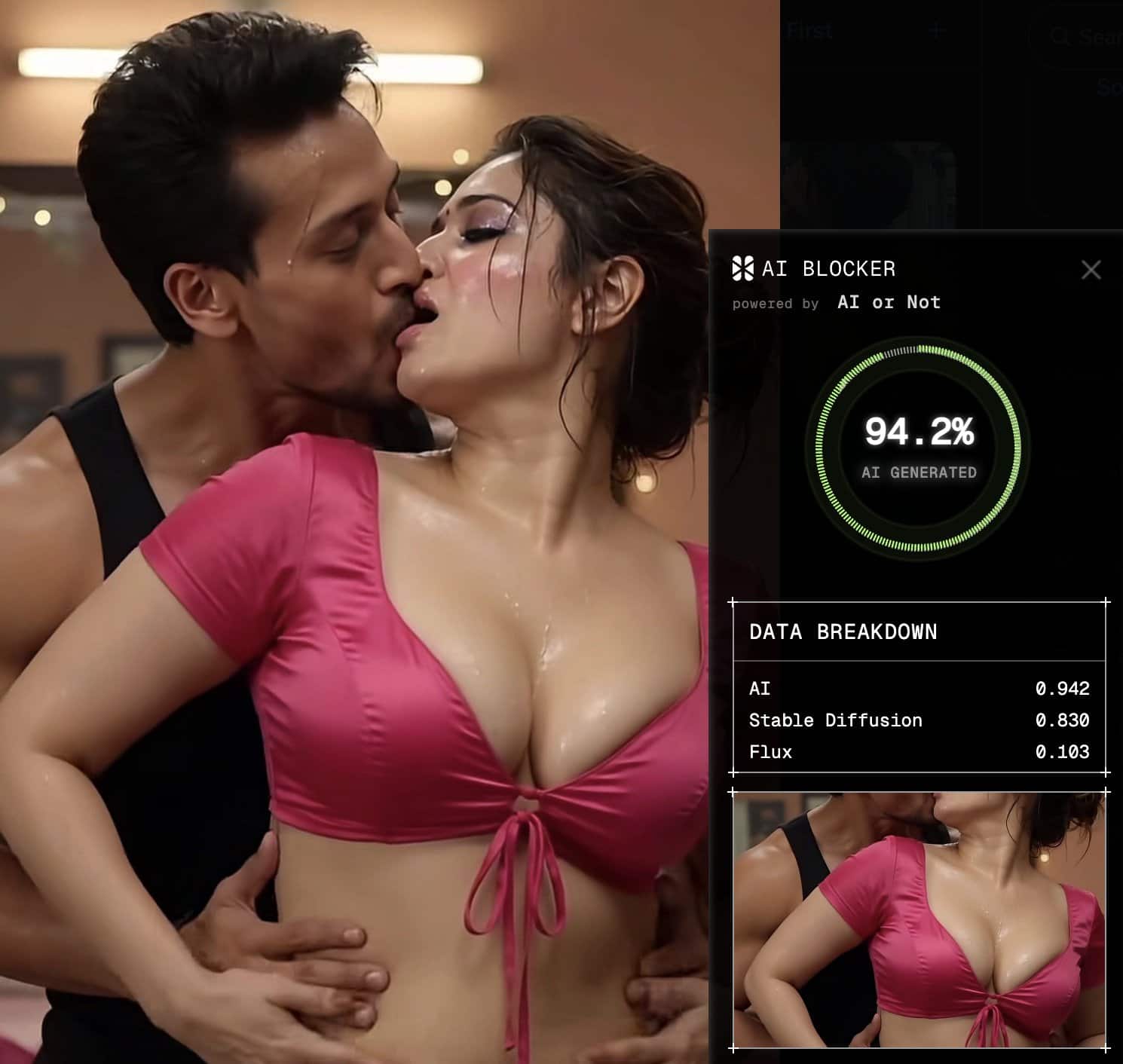
About $45 million (378 crore rupees) worldwide for Kabir Singh (2019). Shershaah (2021) as the most-streamed Indian film on Prime Video at release. Game Changer (2025) opposite Ram Charan. Kiara Advani's commercial record is one of the strongest of her generation. Tamannaah Bhatia is the actress who played Avanthika in the Baahubali franchise, with a cameo in Stree 2 (2024).
AI or Not flagged the composite image pairing both as AI-generated.
Shruti Haasan
Shruti Haasan is the daughter of Kamal Haasan and has built a parallel career across Hindi and Telugu cinema. Her Hindi commercial work includes Gabbar Is Back (2015) and Welcome Back (2015), both opposite top male leads. More recently, she appeared in Salaar: Part 1 - Ceasefire (2023) opposite Prabhas.
AI or Not flagged the image circulating under her name as AI-generated. We've withheld the image and the matching detection panel because both depict explicit non-consensual content.
Pooja Hegde
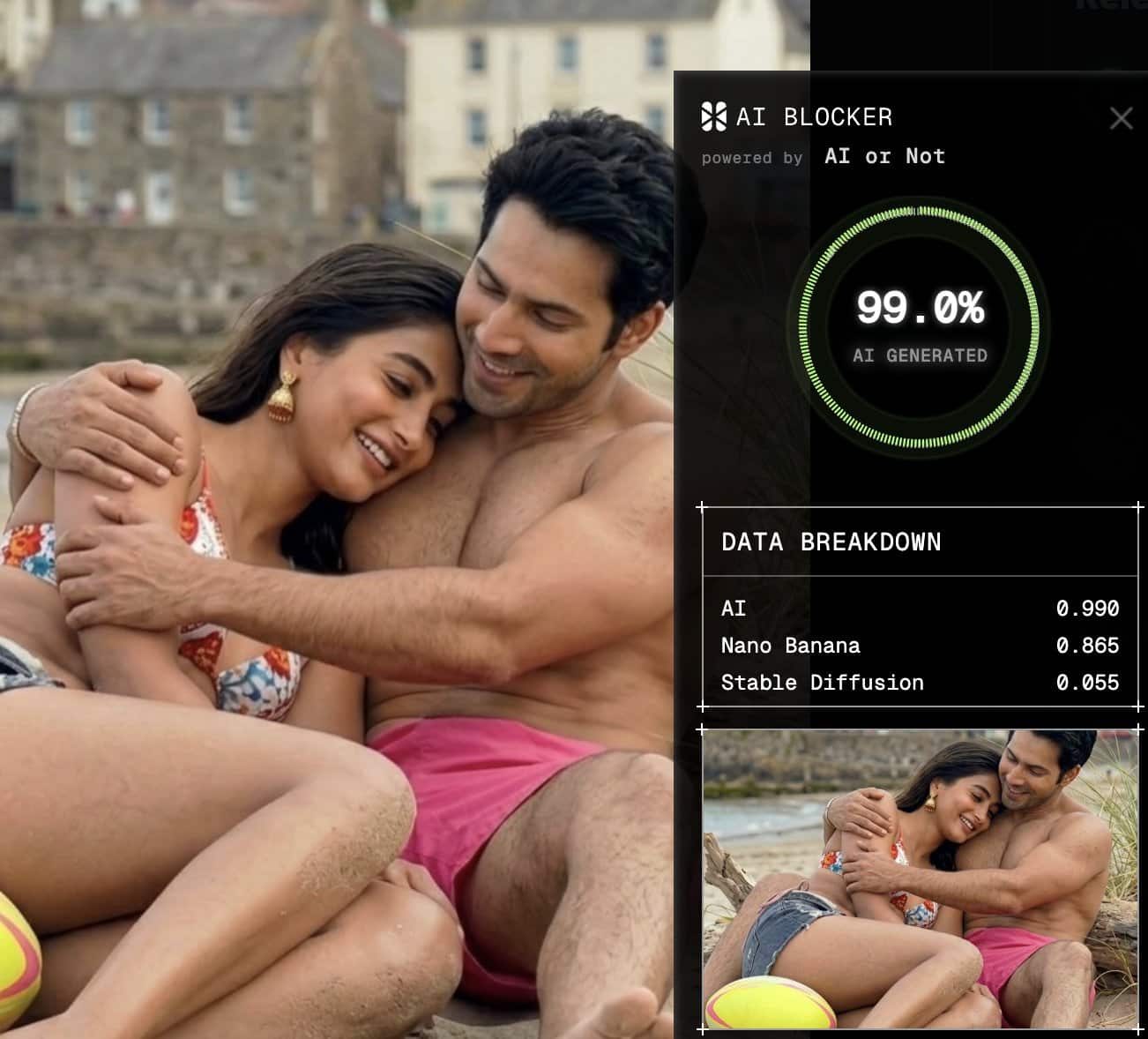
Pooja Hegde has worked across the biggest-budget productions in Hindi cinema: Housefull 4 (2019, about $35 million / 2.9 billion rupees gross), Radhe Shyam (2022) opposite Prabhas, Cirkus (2022) opposite Ranveer Singh, and Kisi Ka Bhai Kisi Ki Jaan (2023) opposite Salman Khan. The fan-account post pairing her with Varun Dhawan contained a four-image grid of AI-generated variants from the same prompt set, and already had a community note rating prompt attached at the time of capture, meaning X users had flagged it. The post was still up. The beach-scene variant below is one of the four; AI or Not flagged it as AI-generated. We've omitted the explicit variants from the same grid.
Nora Fatehi
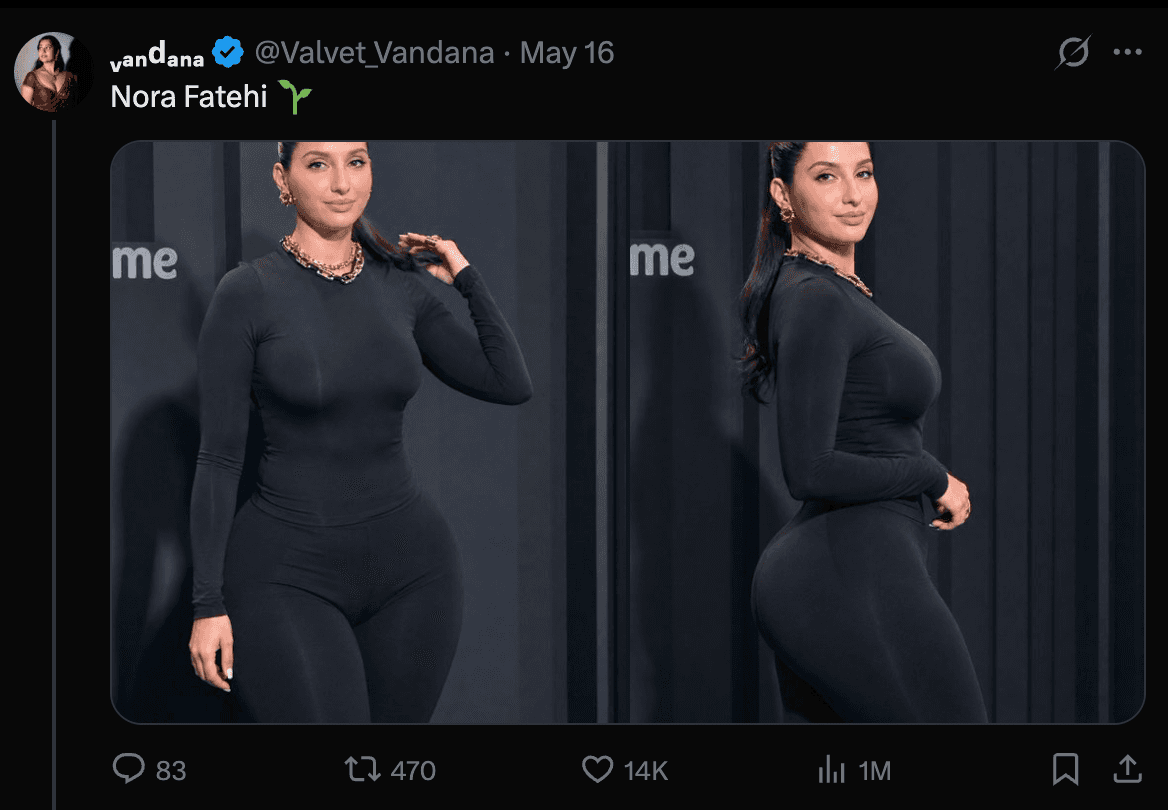
Before she was a film actress, Nora Fatehi was already one of the most-viewed performers in Hindi cinema. "Dilbar" from Satyameva Jayate (2018) was the first Hindi song to cross 20 million YouTube views in 24 hours. In March 2021, she became the first African-Arab artist with a Hindi song crossing 1 billion views. Film credits: Bharat (2019), Street Dancer 3D (2020). AI or Not flagged the image circulating under her name as AI-generated.
Tridha Choudhury
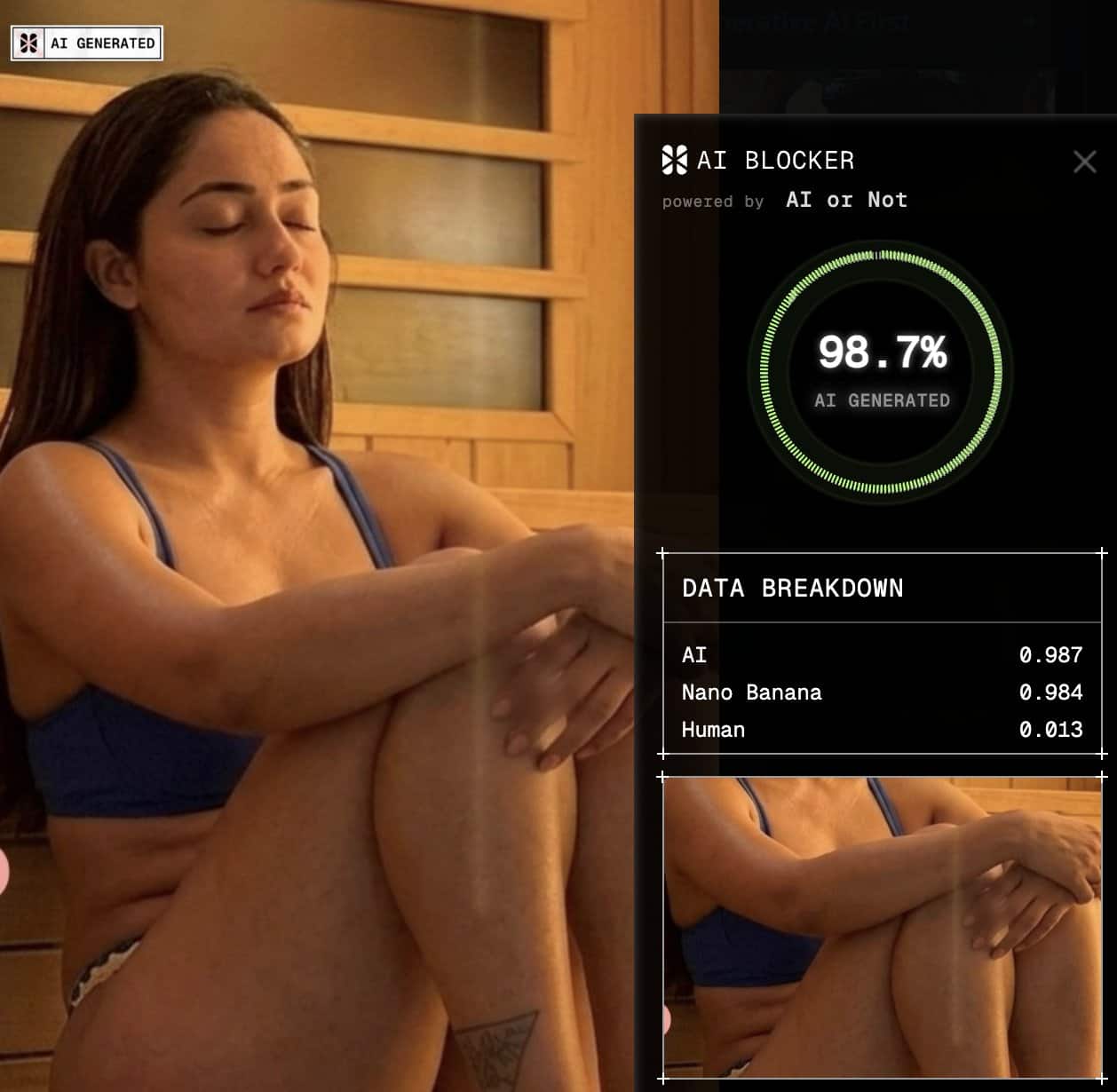
Tridha Choudhury built her profile through streaming: Bandish Bandits (2020, Amazon Prime) and Aashram (2020, MX Player) opposite Bobby Deol brought her significant visibility. The post under her name contained multiple AI-generated sauna variants. The variant below is one of them, flagged AI-generated. The other variants in the same grid are explicit and have been withheld.
How AI-Generated Bollywood Deepfakes Are Made
The images circulating in this batch are produced by openly available image generators, often for free, that can be fine-tuned on a small collection of public celebrity photos to lock a specific face into the output.
According to research published at the 2025 ACM Conference on Fairness, Accountability, and Transparency, this fine-tuning process now requires as few as 20 images, 24GB of VRAM, and about 15 minutes of run time. Consumer-grade hardware. The generators don't need to be hosted anywhere public, they run locally, and the output gets posted from an anonymous account.
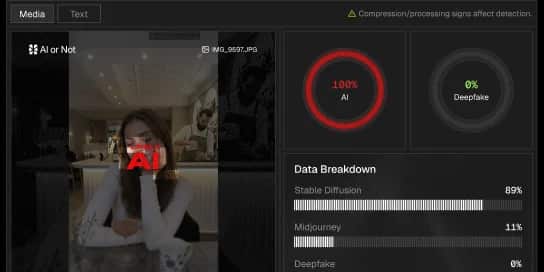
AI or Not detects AI-generated and deepfake images, videos and audio across all major generators, which means the output can be flagged even when the generation source isn't clearly marked.
India's Deepfake Legal Crackdown in 2025
India's courts and regulators spent 2025 building out the legal architecture for personality rights and synthetic-content disclosure, largely from scratch, under pressure from cases that kept arriving faster than the legislature could act.
Indian Personality Rights Rulings on Deepfakes
The first major ruling of the year came on May 30, 2025, when Justice Saurabh Banerjee of the Delhi High Court issued what the order called a "dynamic+" injunction in Sadhguru Jagadish Vasudev and Anr. v. Igor Isakov and Ors. (CS(COMM) 578/2025). The order protected name, image, likeness, voice, and every aspect of persona against AI misuse. It established a 36-hour takedown schedule and, more significantly, directed YouTube and similar platforms to deploy automated detection technology to proactively find and delete identical infringing content, not just the specific URLs identified in the complaint. That last part was new. Every personality-rights ruling that followed in 2025 built on that template.
On September 9, 2025, the Delhi HC granted Aishwarya Rai Bachchan an ex-parte interim injunction in CS(COMM) 956/2025. The order covered AI-generated explicit deepfakes, chatbot impersonation, and unauthorized merchandise carrying her likeness. Government authorities were directed to block infringing URLs within 7 days. It was the clearest ruling against AI-generated intimate content using a specific actress's likeness, and it came through civil action rather than a criminal referral.
November 2025 produced two more orders in the same pattern. The Delhi HC directed Google to remove two YouTube channels hosting deepfakes of journalist Rajat Sharma within 36 hours, following the Sadhguru precedent on automated detection. Separately, the court granted Ankur Warikoo standing liberty to report future instances of deepfake misuse, with platforms again directed to act within 36 hours. By the time the IT Rules took effect in mid-November, the 36-hour window had already been written into four separate injunctions. The regulation was following the courts, not leading them.
India's IT Rules and Deepfake Disclosure Regime
MeitY announced the IT (Intermediary Guidelines) Amendment Rules 2025 on October 22, 2025; they came into force on November 15, 2025, with full penalty enforcement expected to extend into early 2026. The rules establish a statutory definition: "synthetically generated information" means information artificially or algorithmically created, generated, modified, or altered using a computer resource in a manner that appears reasonably authentic or true.
The disclosure architecture has several layers. Platforms that allow creation or dissemination of AI-generated content must ensure that content carries a prominent visible label. For visual content, the label must cover at least 10% of the total surface area of the frame. For audio content, the disclosure must appear in the first 10% of the total duration. Developers uploading content must declare whether it is synthetically generated, and platforms are required to deploy reasonable technical measures, including automated tools, to verify the accuracy of those declarations.
Takedown windows are tiered by severity. Nude or highly invasive deepfakes must come down within 2 hours of a valid complaint. Intimate images more broadly fall under a 36-hour window. Other synthetically generated information complaints must be resolved within 7 days. Platforms that fail to comply lose their Section 79 safe-harbour protection under the IT Act 2000, which means they become directly liable for content they host.
The Digital Personal Data Protection Act 2023 adds a parallel exposure. Deepfakes that process biometric data, and a person's likeness counts as biometric data under the Act, without meaningful consent violate the DPDP Act. Fines for major violations are capped at about $30 million (250 crore rupees). Section 66E of the IT Act, which predates all of this, still carries up to 3 years' imprisonment and a minimum fine of about $2,400 (2 lakh rupees) for non-consensual intimate imagery violations. The legal analysis from MediaNama covers the overlap between the personality-rights case law and the DPDP Act in detail.
What India's New IT Rules Mean for These Bollywood Deepfake Posts
As of that date, the accounts posting this content have a statutory labeling obligation they are clearly not meeting. A visible label covering 10% of the frame is required. None of the posts shown carry one.
The "AI GENERATED" overlay applied by AI or Not's detection interface in the screenshots is a reasonable approximation of what a compliant label would look like in practice, except it's voluntary, applied by a detector after the fact, rather than mandatory and built into the post at the moment of upload. The gap between those two things is where the rules are now trying to intervene.
Under the tiered takedown schedule, the 2-hour clock applies to nude or highly invasive content. Most of the images in this batch would fall under the 36-hour intimate-imagery window. The Pooja Hegde post already had a community note flagging prompt attached at time of capture, meaning the content had been user-reported; under the new rules, a valid complaint should trigger the platform's 36-hour countdown from that point. The post was still up.
This is the first national disclosure regime that puts the labeling and takedown burden on the platform rather than requiring each victim to file a separate legal action. Whether platforms actually comply is a different question, and the answer so far is not encouraging.
How to Verify a Bollywood Celebrity Deepfake
If you come across an image of a Bollywood celebrity (or anyone else) that looks off, here's what to do:
- Run it through AI or Not's detector at aiornot.com. Upload the image directly. The result comes back in seconds, with a model-level breakdown when one is available.
- Check the account posting it. Fan-tribute accounts that mix real promotional photos with generated content in the same grid are a consistent pattern.
- High view counts on a new account with no posting history are not a coincidence. They reflect algorithmic amplification of content designed to maximize engagement, which this content is.
- To report deepfakes of Indian celebrities on X, use X's Safety tools and flag under non-consensual nudity. For legal escalation in India, the Ministry of Electronics and IT operates the Cyber Crime portal.
Bollywood Deepfake Detection FAQ
How can I tell if a Bollywood celebrity photo is AI-generated?
Bollywood celebrity deepfake detection has gotten harder as image generators have improved — older outputs had obvious hand and finger artifacts, but newer ones are significantly cleaner. The most reliable approach is running the image through an AI detector like AI or Not, which checks for generator-level signatures rather than visual artifacts alone. Account context matters too: images posted by accounts that mix real press photos with generated content, or that use relationship bait in the caption, are a common pattern for this type of content.
Is making deepfakes of Bollywood actresses illegal in India?
Distributing non-consensual intimate imagery in India can attract prosecution under Section 66E of the IT Act, which carries up to 3 years' imprisonment and a minimum fine of about $2,400 (2 lakh rupees). The IT Amendment Rules effective November 15, 2025 add platform-level obligations: synthetic content must be labeled, and non-consensual nude deepfakes must be taken down within 2 hours of a valid complaint, with intimate images more broadly covered by a 36-hour window. The Digital Personal Data Protection Act 2023 adds a separate exposure for processing biometric data, including a person's likeness, without meaningful consent, with fines up to about $30 million (250 crore rupees) for major violations. Civil remedies are also available: Sadhguru's May 2025 Delhi HC injunction established the "dynamic+" personality-rights framework that courts applied again to Aishwarya Rai Bachchan in September 2025 and Rajat Sharma in November 2025. Enforcement against anonymous offshore accounts remains inconsistent.
What was the Rashmika Mandanna deepfake case about?
In November 2023, a video went viral on X in which Rashmika Mandanna's face had been swapped onto footage of British-Indian influencer Zara Patel walking into an elevator. The original video belonged to Patel, who said she had no involvement with the manipulation. Mandanna said publicly that the experience was "extremely scary" and called attention to how broadly vulnerable people are to this kind of misuse. Delhi Police registered an FIR in the case. The incident is widely credited with pushing deepfake regulation onto India's legislative agenda.
How Are AI-Generated Bollywood Deepfakes Created?
The images flagged in this investigation are produced by openly available image generators that can be fine-tuned on a small set of publicly available celebrity photos using a technique called LoRA (low rank adaptation). According to 2025 ACM research, the fine-tuning process now requires as few as 20 images and about 15 minutes on consumer hardware. The output is then posted from anonymous accounts, making source tracing difficult — which is why detectors like AI or Not focus on what the image itself reveals about how it was made, rather than on tracing it back to a creator.
What is India's new deepfake disclosure law?
The IT (Intermediary Guidelines) Amendment Rules 2025 came into force on November 15, 2025, with full penalty enforcement expected to extend into early 2026. Any platform that allows creation or dissemination of AI-generated content must ensure that content carries a visible label covering at least 10% of the frame. Takedown windows are tiered: 2 hours for nude or highly invasive deepfakes, 36 hours for intimate images, and 7 days for other synthetically generated content after a valid complaint. Platforms that fail to comply lose their Section 79 safe-harbour protection under the IT Act 2000, making them directly liable for hosted content.
Where can I report a deepfake of a Bollywood celebrity?
On X, use the platform's built-in safety reporting tools and select non-consensual nudity as the category. Under India's IT Rules, a valid complaint should trigger a 2-hour takedown window for nude or highly invasive content and a 36-hour window for other intimate imagery. The National Cyber Crime Reporting Portal accepts complaints about deepfakes and non-consensual imagery. Affected individuals can also pursue civil relief through Indian courts, following the personality-rights framework established by the Sadhguru and Aishwarya Rai Bachchan injunctions. For broader documentation of AI-generated misinformation circulating on Indian platforms, AI or Not's blog tracks ongoing incidents.
The posts in this investigation had view counts between 100,000 and well over a million. Under the November 2025 IT Rules, a valid complaint against nude or highly invasive content starts a 2-hour countdown; for the broader intimate-imagery category covering most of the screenshots here, the window is 36 hours. The "Make It Real" study from Tattle Civic Tech and the RATI Foundation found that 10% of all calls to their abuse helpline in 2025 now involve deepfakes. The harm is no longer hypothetical, and it's no longer just at the top of the celebrity pyramid.
Mandanna said in 2023 that something like this was "extremely scary." She was describing a face-swap. The images in these screenshots weren't taken from her. They were generated wholesale. The technology moved. The 36-hour clock is now running.

What do you get with AI or Not?
Instantly get your AI detection API to start building, and protecting.

AI detection covering images, text, video and audio.
All content checked gets deleted, instantly.
Start detecting AI for free, scale with pay-as-you-go.
AI to fight AI.
